

Published: April 23, 2026
Author: Ali Nasir
NetNewsflix News Desk Reading Time: 9 minutes
The Memo That Changed 8,000 Lives
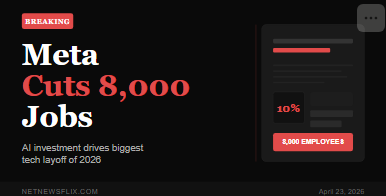
On the morning of April 23, 2026, thousands of Meta employees opened their work emails to find a message they had been dreading for months. The subject was simple. The contents were not. Meta — the parent company of Facebook, Instagram, and WhatsApp — confirmed that it is laying off approximately 8,000 employees, representing 10 percent of its entire global workforce. The cuts will begin on May 20. There will be no severance negotiations, no extended timelines. The decision has been made.
For the 8,000 workers who will lose their jobs, this is a personal catastrophe. For the technology industry, it is the latest chapter in a seismic shift that is rewriting the rules of how Silicon Valley operates. And for the rest of the world, it raises a question that is becoming impossible to ignore: is artificial intelligence taking over — and what does that mean for the future of work?
This is the full story of Meta’s 2026 layoffs, what is driving them, who is affected, and what it all means for you.
What Exactly Did Meta Announce?
The news broke through an internal memo sent by Meta’s Chief People Officer, Janelle Gale, to all employees on Thursday, April 23, 2026. Bloomberg was first to report on the contents of the memo, and within hours it had been confirmed by multiple major news outlets including CBS News, CNBC, TechCrunch, and The New York Times.
The key details are as follows. Meta will cut approximately 8,000 jobs, which equals 10 percent of its total workforce. As of the end of 2025, Meta employed 78,865 people across offices in more than 90 cities worldwide. In addition to the 8,000 layoffs, Meta is also canceling plans to hire for 6,000 open roles that the company had previously intended to fill. The effective date for the layoffs is May 20, 2026.
In the memo, Gale wrote that the cuts were part of the company’s continued effort to run more efficiently and to offset other investments being made. She acknowledged that the decision would be painful, noting that letting go of people who had made meaningful contributions to Meta during their time there was not an easy tradeoff.
Meta shares fell more than 2 percent in afternoon trading following the announcement, closing at around $659, as investors processed the news alongside broader market uncertainty driven by rising global oil prices and the ongoing geopolitical crisis in the Middle East.
This Is Not Meta’s First Rodeo — A History of Layoffs
To understand why Meta is doing this, it helps to know where the company has been. The 2026 cuts are not an isolated incident. They are the latest in a pattern of aggressive workforce reduction that began a few years ago.
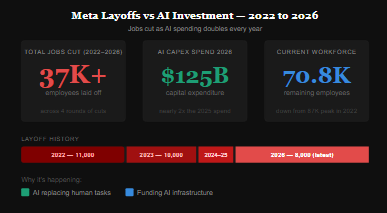
Back in late 2022, Meta shocked the tech world by laying off about 11,000 employees — roughly 13 percent of its workforce at the time — in what CEO Mark Zuckerberg called a painful but necessary correction after years of overhiring during the pandemic boom. He called 2023 the “Year of Efficiency” and promised to make Meta leaner and more focused.
In early 2023, another round of cuts followed, eliminating roughly 10,000 more positions. Then in 2024 and 2025, smaller targeted reductions continued across various departments. In March 2026, just weeks before this latest announcement, Meta made another set of cuts affecting hundreds of employees — described at the time as routine performance-based reductions.
Now comes the 2026 wave: 8,000 jobs gone and 6,000 roles never filled. In total, Meta has reduced its workforce significantly from its peak hiring days of 2021 and 2022, when the company was expanding rapidly into the metaverse and betting big on virtual reality.
What happened to the metaverse dream? It largely did not pan out — at least not on the timeline Zuckerberg envisioned. The pivot to AI is now the company’s defining strategic bet, and the layoffs are the price being paid to fund it.
The Real Reason: Artificial Intelligence
Let’s be direct about what is driving these layoffs. It is not a struggling business. Meta is not in financial trouble. In fact, the company reported record-breaking results for the fourth quarter of 2025, with revenue of $59.89 billion — up 24 percent year over year — and net income of $22.77 billion, up 9 percent. Those are not the numbers of a company in crisis.
The reason Meta is cutting 8,000 jobs while sitting on record profits is artificial intelligence — and specifically, the enormous cost of competing in the AI arms race.
Earlier this year, Meta revealed that it expects to spend between $115 billion and $135 billion on capital expenditure in 2026. That is nearly double the $72.2 billion it spent in 2025. The vast majority of that investment is being poured into AI infrastructure: data centers, chips, computing power, and the development of Meta’s own AI systems through its Meta Superintelligence Labs division.
Wedbush Securities analyst Dan Ives summed up the strategy bluntly. He said that Meta is leveraging AI tools to automate tasks that once required large teams, allowing the company to streamline operations and reduce costs while maintaining productivity. In plain English: the work that 8,000 humans used to do is increasingly being done by software.
This is not unique to Meta. Pinterest has cited AI as a reason for recent job cuts. Chemical maker Dow has done the same. Microsoft, also on April 23, announced it is offering voluntary buyouts to about 8,750 US employees — roughly 7 percent of its domestic workforce. The entire technology sector is going through the same transformation simultaneously, and Meta is simply the largest and most visible example of it right now.
Who Is Being Laid Off?
Meta has not released a detailed breakdown of which teams or departments will be most affected by the cuts. However, based on the pattern of previous Meta layoffs and the company’s current strategic direction, analysts and former employees have pointed to several likely areas of impact.
Roles that involve manual content moderation, general operations, middle management, and non-technical administrative functions are widely expected to bear the heaviest burden. These are precisely the jobs that AI tools are best positioned to replace — tasks that involve pattern recognition, sorting, classification, and rule-based decision making.
On the other hand, engineers working on AI development, infrastructure, and product teams aligned with Meta’s core platforms — Facebook, Instagram, WhatsApp, and Threads — are likely to be more insulated from the cuts. The company is not shrinking its ambitions. It is reshaping what kind of people it needs to execute them.
For the 8,000 employees receiving layoff notices on May 20, the experience will be jarring regardless of their role. Many of them may have survived previous rounds of cuts and assumed they were safe. That assumption, unfortunately, has proven incorrect.
Mark Zuckerberg’s Grand Bet on AI
At the center of all of this is Mark Zuckerberg — Meta’s founder, chairman, and CEO — who has spent the past two years making one of the boldest strategic pivots in corporate history. Having abandoned the metaverse narrative that defined his 2021 and 2022 investor presentations, Zuckerberg has repositioned Meta as an AI-first company with ambitions to compete directly with OpenAI, Google, and Anthropic.
Meta has released its own large language models under the LLaMA brand, which it has made open-source — a deliberate contrast to the closed models of its competitors. It has built AI assistants into Facebook, Instagram, and WhatsApp. It has partnered with chip manufacturers to build custom AI processors. And through Meta Superintelligence Labs, it is pushing into frontier AI research with billions of dollars of investment.
According to CNBC, Meta has openly acknowledged it currently lags behind OpenAI, Google, and Anthropic in developing the most capable AI systems. The layoffs are, in part, a funding mechanism to close that gap. By reducing its human payroll and redirecting those savings into AI infrastructure, Meta is essentially betting that machines will generate more value per dollar spent than the people they replace.
Whether that bet pays off remains to be seen. But Zuckerberg has made it clear he is not interested in half-measures. The company that he built around human connection is now being rebuilt around artificial intelligence — and the human cost of that rebuilding is becoming clearer by the day.
Microsoft Also Makes a Move: Buyouts for 8,750 Workers
Meta was not alone on April 23 in making a significant workforce announcement. Microsoft — the software giant behind Windows, LinkedIn, and GitHub — revealed that it is offering voluntary buyouts to approximately 8,750 US employees, about 7 percent of its domestic workforce.
The Microsoft offer is structured differently from Meta’s layoffs. Rather than involuntary terminations, Microsoft is giving employees the choice to leave in exchange for a financial package. The offers are expected to go out in early May. While the voluntary nature of the buyouts is a softer approach than Meta’s outright cuts, the underlying logic is identical: reduce human headcount to fund AI investment.
Microsoft has been one of the most aggressive AI investors in the industry, having committed billions to OpenAI and embedded AI tools — branded as Copilot — across its entire product suite, from Office 365 to Azure to GitHub. Like Meta, Microsoft is betting that AI-powered productivity gains will more than compensate for the reduction in human staff.
The fact that both companies made major workforce announcements on the exact same day sent a powerful signal to the entire tech industry. The age of large-scale human workforce expansion in Silicon Valley may be coming to an end. What is replacing it is an era of AI-powered efficiency — which is another way of saying fewer jobs, more automation, and higher profit margins for the companies that execute the transition successfully.
What Does This Mean for the Global Job Market?
The Meta and Microsoft announcements are not happening in a vacuum. They are part of a much larger trend that economists and labor analysts have been warning about for years: the displacement of white-collar, knowledge-economy jobs by artificial intelligence.
For decades, the conventional wisdom was that AI would replace manual, repetitive, blue-collar work — factory jobs, warehouse jobs, truck driving. But the AI tools that have emerged in the past three years are increasingly capable of performing knowledge work: writing, analyzing, coding, moderating, planning, and communicating. The white-collar world is no longer insulated.
The people losing jobs at Meta are not factory workers. They are college-educated professionals in their twenties, thirties, and forties who built careers on the assumption that human judgment, creativity, and communication skills were irreplaceable. That assumption is being challenged at scale, and the disruption is only beginning.
As AI reshapes the labor market, workers who can adapt and reskill will fare better than those who cannot. But not everyone has equal access to the tools, education, and support systems needed to make that transition. The risk is that the benefits of the AI revolution flow primarily to shareholders and executives, while the costs are borne disproportionately by ordinary workers.
Meta’s Financial Picture: Strong Numbers, Uncomfortable Questions
There is a tension at the heart of Meta’s decision that deserves honest examination. The company is cutting 8,000 jobs while reporting record profits and planning to spend over $100 billion on AI infrastructure in a single year. That combination raises uncomfortable questions about the ethics of mass layoffs at highly profitable companies.
Defenders of Meta’s approach will argue that companies must invest aggressively to remain competitive, and that failing to make the AI transition would ultimately lead to far more job losses in the long run. They will point out that Meta’s advertising revenue — which drives nearly all of its income — depends on staying technologically ahead of rivals like TikTok, YouTube, and Snapchat.
Critics will argue that a company generating $22 billion in quarterly net income has more than enough resources to retain its workforce while still funding AI development. They will question whether the drive for efficiency is really about survival, or simply about maximizing shareholder returns at the expense of the people who built the company.
Both arguments have merit. What is clear is that the decision has been made, and for the 8,000 people losing their jobs on May 20, the philosophical debate offers little comfort.
What Happens Next?
Meta is scheduled to report its first quarter 2026 financial results on April 29 — just days from now. Investors and analysts will be watching closely to see whether the company’s AI investments are beginning to translate into measurable revenue growth, and whether the layoffs are having the intended effect on operating costs.
More layoffs may be coming later in 2026. Reuters reported earlier this month that Meta is considering an additional round of cuts, though the scale has not been confirmed. If the company continues to find ways to automate functions previously performed by humans, further workforce reductions remain a realistic possibility.
For workers across the technology industry, the message from this week is difficult to ignore: no role is entirely safe, surviving previous rounds of cuts does not guarantee protection in the next one, and the pace of AI-driven change is accelerating rather than slowing down.
For the rest of us — the consumers who use Facebook, Instagram, and WhatsApp every day — the changes at Meta may be largely invisible. But they will shape the platforms we use, the content we see, and ultimately the kind of digital world we all live in.
Conclusion: The Human Cost of the AI Gold Rush
April 23, 2026 will be remembered as a significant day in the history of artificial intelligence — not because of a breakthrough discovery or a new product launch, but because of what it cost. Meta’s 8,000 layoffs and Microsoft’s buyout offers to 8,750 workers are individual corporate decisions. But together, they tell a story about where we are headed as a society.
AI is not coming. It is here. It is already influencing who keeps their job and who does not. The companies driving this transformation are not slowing down. They are accelerating, quarter by quarter, billion by billion.
The real question is not whether this transformation will happen — it already is. The question is who benefits from it, and who is left behind. That question does not have an easy answer. But it is the most important question of our time, and it deserves to be asked loudly and honestly.
For 8,000 Meta employees, the answer becomes real on May 20.
NetNewsflix will continue tracking this story and all major tech developments. Bookmark this page and stay informed.
Source: Bloomberg, CNBC, CBS News, TechCrunch, Variety — April 23, 2026
Sources & References
- Bloomberg — Meta Tells Staff It Will Cut 10% of Jobs
- CBS News — Meta Plans to Lay Off Roughly 8,000 Employees

Ali Nasir is a news writer and journalist at NetNewsflix, covering global affairs, geopolitics, and breaking world news. With a sharp eye for detail and a passion for keeping readers informed, Ali breaks down complex international stories — from Middle East conflicts to global economic crises — into clear, compelling reporting that matters.