

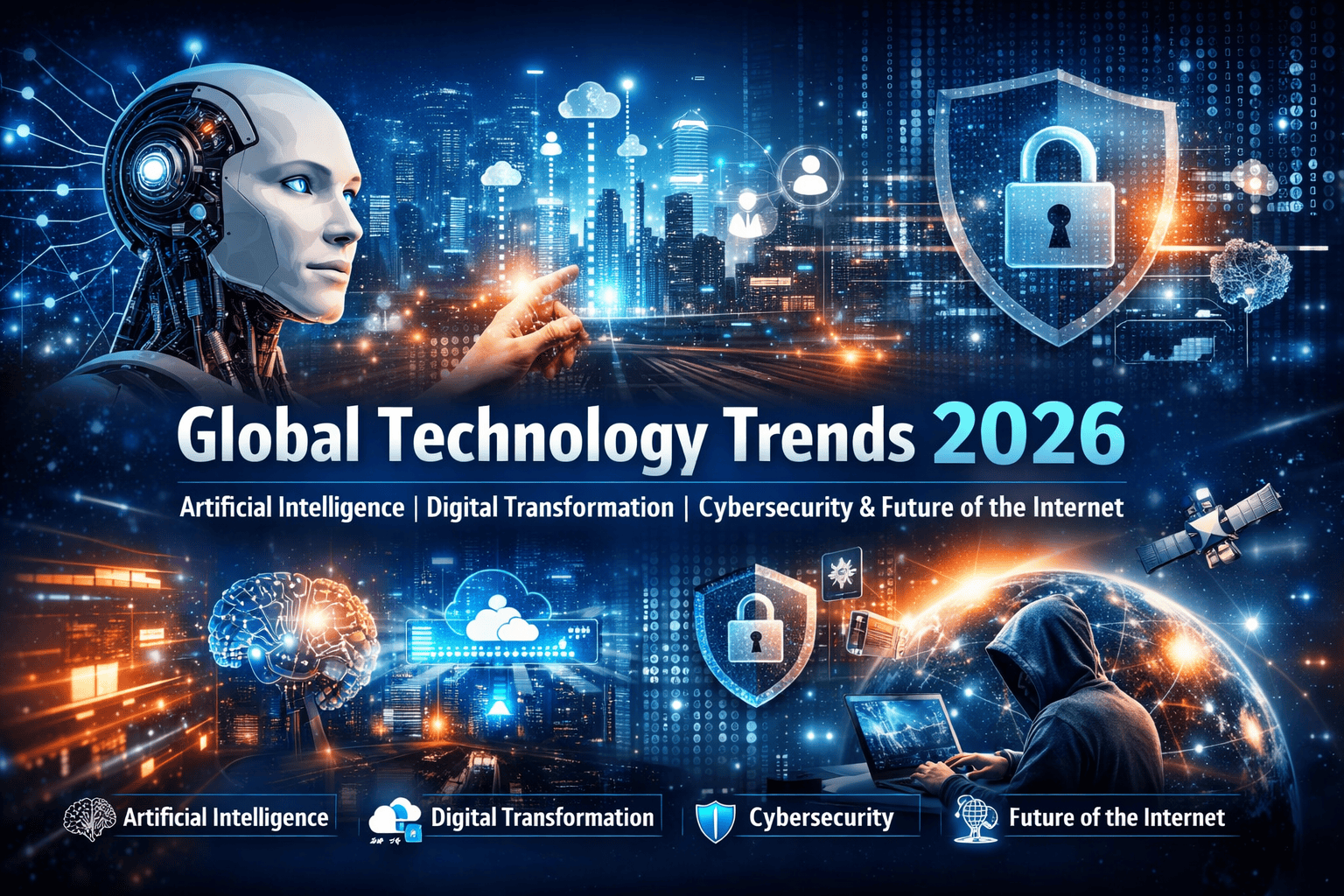
📌 Introduction: The World Is Entering a New Digital Era
The global technology landscape in 2026 is undergoing one of the most significant transformations in human history. Every aspect of life, including communication, business, education, healthcare, entertainment, and governance, is now deeply connected with digital systems. This transformation is not gradual anymore; instead, it is happening at an extremely fast pace driven by artificial intelligence, automation, cloud computing, and high-speed internet infrastructure.
Experts describe 2026 as the “full digital integration year,” where physical and digital environments are merging together. Businesses are no longer optional users of technology; instead, they are fully dependent on it for survival and growth. Individuals are also increasingly relying on smart devices, AI assistants, and online platforms for daily activities.
This article provides a complete, in-depth analysis of global technology trends shaping the world in 2026, including artificial intelligence, cybersecurity, digital transformation, streaming evolution, cloud systems, and the future of the internet.
🤖 Artificial Intelligence: The Most Dominant Technology of 2026
Artificial intelligence has become the most influential technology of the modern era. In 2026, AI is no longer a futuristic concept; it is actively integrated into nearly every industry. From small startups to multinational corporations, AI systems are being used to automate tasks, analyze data, and enhance decision-making processes.
One of the biggest advancements in AI is generative intelligence, which allows machines to create text, images, videos, and even software code. This development has completely changed industries such as marketing, content creation, software development, and customer service.
AI-powered assistants are now capable of handling complex human-like conversations, scheduling tasks, analyzing business data, and providing real-time solutions. In healthcare, AI is helping doctors diagnose diseases more accurately by analyzing medical imaging and patient history.
However, this rapid growth also raises concerns about job displacement. Many traditional roles are being replaced by automated systems, leading to a shift in workforce demand toward creative, analytical, and technical roles.
Despite these challenges, AI is expected to contribute trillions of dollars to the global economy over the next decade, making it the backbone of future technological development.
🌍 Digital Transformation: Redefining Global Industries
Digital transformation refers to the integration of digital technology into all areas of business and society. In 2026, this transformation has reached almost every industry, from banking and retail to healthcare and education.
Businesses are rapidly moving away from traditional systems and adopting cloud-based platforms. This shift allows organizations to operate more efficiently, reduce costs, and improve customer experiences. Remote working systems have also become a standard practice in many companies, allowing employees to work from anywhere in the world.
In education, digital transformation has led to the rise of online learning platforms, virtual classrooms, and AI-based tutoring systems. Students now have access to global knowledge resources without geographical limitations.
Healthcare systems are also evolving through telemedicine services, where patients can consult doctors remotely using video calls and AI-powered diagnostic tools.
Governments are adopting digital governance systems to improve public services, reduce corruption, and increase transparency.
Overall, digital transformation is reshaping how societies function, making processes faster, smarter, and more efficient.
🔐 Cybersecurity: The Growing Global Concern
As technology advances, cybersecurity threats are also increasing at an alarming rate. In 2026, cybercrime has become one of the most serious global challenges affecting individuals, businesses, and governments.
Hackers are using advanced tools such as AI-powered malware, phishing attacks, ransomware, and identity theft techniques to exploit digital systems. Data breaches are becoming more frequent, exposing sensitive personal and corporate information.
To combat these threats, organizations are investing heavily in cybersecurity infrastructure. Advanced encryption technologies, multi-factor authentication systems, and AI-based threat detection systems are now widely used to secure digital environments.
Governments are also introducing strict regulations to protect user data and ensure digital safety. However, cybersecurity remains an ongoing battle, as attackers continuously develop more sophisticated methods.
Experts emphasize that cybersecurity awareness is now essential for every internet user, as digital threats can affect anyone at any time.
📡 The Evolution of Streaming and Digital Entertainment
The entertainment industry has undergone a massive shift from traditional television to digital streaming platforms. In 2026, most users prefer on-demand content over scheduled broadcasting.
Streaming platforms offer users the ability to watch movies, TV shows, documentaries, and live events anytime and anywhere. This flexibility has made streaming services extremely popular worldwide.
Personalized recommendation systems powered by AI have further improved user experience by suggesting content based on viewing behavior and preferences.
The rise of mobile devices and smart TVs has also contributed to the growth of digital entertainment. Users are now consuming content across multiple devices seamlessly.
Gaming and interactive media are also evolving rapidly. Cloud gaming, virtual reality (VR), and augmented reality (AR) technologies are creating immersive entertainment experiences that were not possible in the past.
☁️ Cloud Computing: The Backbone of Modern Technology
Cloud computing is one of the most important technologies driving digital transformation. It allows users and businesses to store, manage, and process data over the internet instead of local systems.
In 2026, almost every major organization relies on cloud infrastructure for its operations. Cloud platforms provide scalability, flexibility, and cost efficiency, making them essential for modern businesses.
Cloud computing also enables remote access to data, allowing employees to work from anywhere in the world. This has significantly contributed to the growth of remote working culture.
Additionally, cloud systems are integrated with AI and big data analytics, allowing companies to process large amounts of information and make data-driven decisions.
📊 Big Data and Analytics: The Power of Information
Every digital interaction generates data, and this data is becoming one of the most valuable assets in the world. Big data analytics allows organizations to process large volumes of information to identify patterns, trends, and insights.
In 2026, companies use data analytics to understand customer behavior, improve products, and increase sales. AI systems combined with big data can predict future trends with high accuracy.
This capability gives businesses a competitive advantage in the market, allowing them to make smarter decisions faster than ever before.
📱 Internet of Things (IoT) and Smart Devices Expansion
The Internet of Things (IoT) refers to the network of interconnected devices that communicate with each other through the internet. In 2026, IoT has expanded significantly into homes, cities, industries, and transportation systems.
Smart homes are now equipped with devices such as smart lights, thermostats, security systems, and voice-controlled assistants. These systems improve convenience, energy efficiency, and security.
Smart cities are also being developed with advanced infrastructure such as traffic management systems, smart energy grids, and digital monitoring systems.
IoT is expected to play a major role in building fully automated environments in the future.
📡 5G and Future Internet Technologies
5G technology has revolutionized internet connectivity by providing ultra-fast speeds and low latency. This has improved mobile communication, streaming quality, and online gaming experiences.
In 2026, research and development of 6G technology has already begun. 6G is expected to offer even faster speeds, holographic communication, and advanced AI integration.
The future internet will likely be fully immersive, enabling real-time interaction between physical and digital environments.
💼 Remote Work and the Digital Economy
Remote work has become a permanent part of the global workforce. Many companies now operate hybrid or fully remote systems, allowing employees to work from anywhere.
This shift has led to the rise of the digital economy, where online jobs and freelance work are becoming increasingly common. High-demand roles include software development, AI engineering, cybersecurity, and digital marketing.
The flexibility of remote work has also improved work-life balance for millions of employees worldwide.
⚖️ Ethical Challenges in Technology
While technology is advancing rapidly, it also brings ethical challenges. Issues such as data privacy, AI misuse, digital addiction, and job displacement are becoming major concerns.
Governments and organizations are working to create ethical frameworks to regulate technology usage and ensure responsible innovation.
Balancing technological progress with ethical responsibility is one of the biggest challenges of the modern era.
🔮 Future Outlook: What Lies Ahead
The future of technology is expected to be even more advanced and interconnected. Experts predict that artificial intelligence will become fully autonomous, internet systems will become faster and more immersive, and digital environments will replace many physical interactions.
Human life will become increasingly dependent on digital systems, making technology the central pillar of global development.
📌 Conclusion
The year 2026 marks a major turning point in global technological evolution. Artificial intelligence, cybersecurity, cloud computing, digital transformation, and internet technologies are reshaping the world at an unprecedented speed.
While these advancements bring convenience, efficiency, and innovation, they also introduce challenges that require careful management. The future will depend on how responsibly humanity uses these powerful technologies.
Frequently Asked Questions (FAQs)
1. What are the major technology trends in 2026?
The major technology trends in 2026 include artificial intelligence, digital transformation, cybersecurity advancements, cloud computing, big data analytics, and the expansion of IoT (Internet of Things). These technologies are reshaping industries, businesses, and daily life globally.
2. Why is Artificial Intelligence so important in 2026?
Artificial intelligence is important because it automates tasks, improves decision-making, and enhances productivity across industries. In 2026, AI is widely used in healthcare, business, education, and entertainment, making it one of the most influential technologies in the world.
3. How is digital transformation changing businesses?
Digital transformation is helping businesses move from traditional systems to digital platforms. It improves efficiency, reduces costs, enables remote work, and allows companies to use data-driven decision-making for better performance and customer experience.
4. What are the biggest cybersecurity risks in 2026?
The biggest cybersecurity risks include data breaches, ransomware attacks, phishing scams, identity theft, and AI-powered cyberattacks. As technology grows, cybercriminals are also using more advanced tools to target individuals and organizations.
5. How is cloud computing used in modern technology?
Cloud computing is used to store, manage, and process data over the internet instead of local systems. It allows businesses to scale easily, work remotely, improve data security, and reduce operational costs.
6. What is the Internet of Things (IoT)?
The Internet of Things (IoT) is a network of connected devices that communicate with each other through the internet. Examples include smart homes, wearable devices, smart cities, and automated industrial systems.
7. Will AI replace human jobs in the future?
AI may replace some repetitive and manual jobs, but it will also create new opportunities in fields like AI development, data science, cybersecurity, and digital innovation. The future workforce will shift toward more creative and technical roles.
8. What is the future of the internet in 2026 and beyond?
The future of the internet includes faster speeds (5G and 6G), AI integration, immersive experiences like virtual reality, and smarter connectivity between devices. The internet will become more intelligent, interactive, and deeply integrated into daily life.

Ali Nasir is a news writer and journalist at NetNewsflix, covering global affairs, geopolitics, and breaking world news. With a sharp eye for detail and a passion for keeping readers informed, Ali breaks down complex international stories — from Middle East conflicts to global economic crises — into clear, compelling reporting that matters.